From jabs to pills: why obesity is now one of clinical research's fastest-growing therapeutic areas
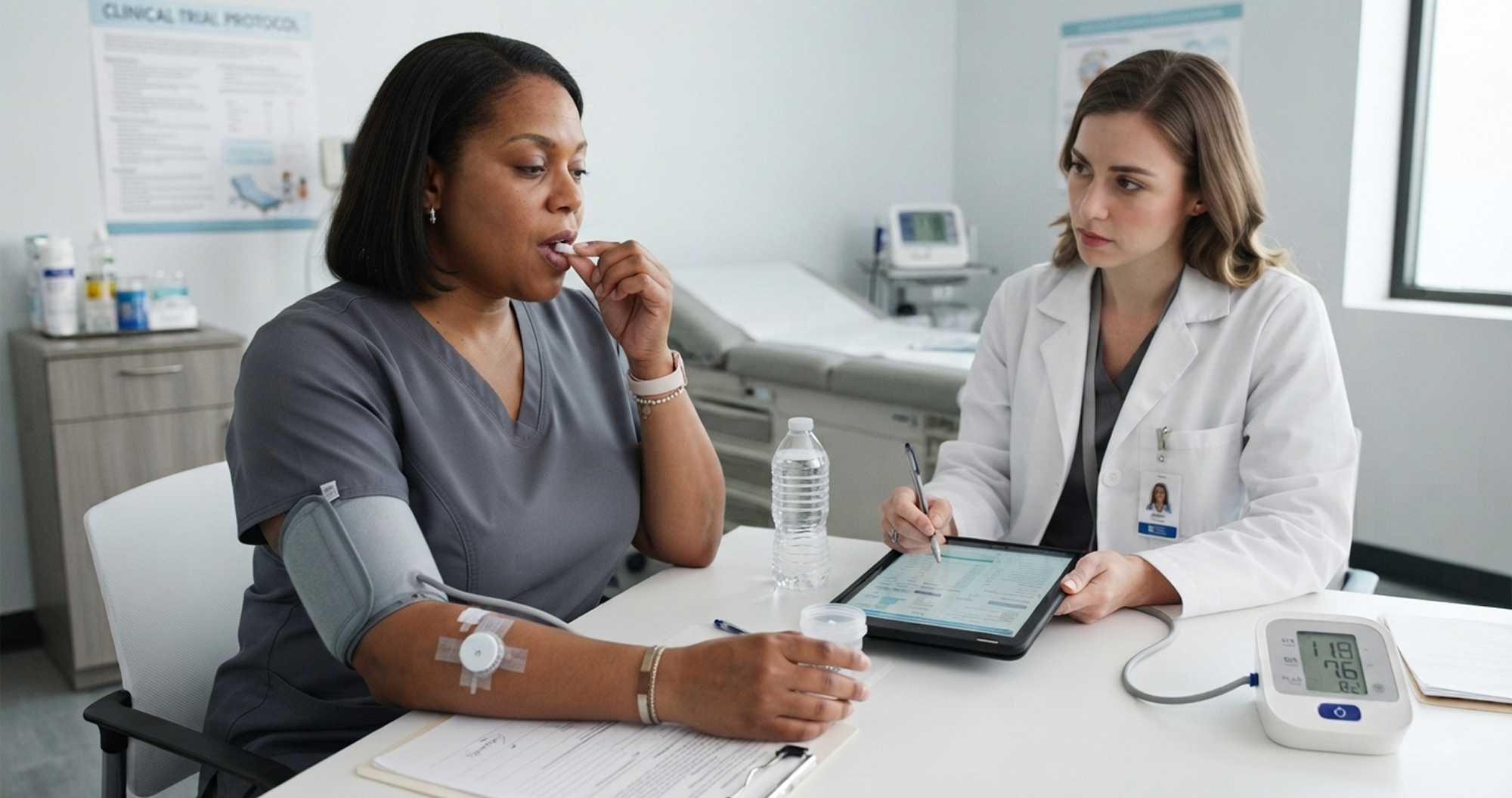
Obesity clinical trials have grown more than five-fold over the past decade, and the pace hasn't slowed. On 10 August 2026, the UK's medicines regulator approved a new once-daily oral GLP-1 treatment for weight loss, making the UK the first country in Europe to license it. [1] Obesity research has moved from injectable pilot studies to daily tablets in well under a decade, and clinical trial supply chains have had to move just as fast to keep up.
From injections to tablets, in record time
Anti-obesity medicines have largely followed a familiar pattern: strong results first, convenience improvements after. Injectable GLP-1 treatments, taken weekly, were the first to show that significant, sustained weight loss was achievable with this class of drug, and patient demand followed quickly. Manufacturers then turned their attention to removing the injection altogether. The UK licensed its first oral GLP-1 weight-loss tablet earlier in 2026, and August's approval adds a second oral option to the market. Each tablet has its own dosing schedule and administration requirements, and it's still early days for working out which formulation suits which patients best.
The newly approved tablet is licensed for adults with a BMI of 30 or above, or 27 to 30 with a weight-related condition such as type 2 diabetes, alongside a reduced-calorie diet and increased physical activity. In trials, the highest dose produced an average 11.2% weight loss over 72 weeks, and just over half of participants lost at least 10% of their body weight. [2] Those figures sit somewhat below results reported for injectable GLP-1 treatments, though patients get the trade-off of no injections in return. NICE is expected to complete its own assessment in November 2026, and a launch date and pricing are still to be confirmed.
The UK isn't approving these treatments in isolation, either. Oral GLP-1 medicines have already cleared regulatory review in other markets, and the pattern looks the same everywhere they land: rapid uptake. In the US, an oral GLP-1 tablet passed three million prescriptions within roughly five months of launch. [3] In the UK, an estimated 1.9 million adults are now using weight-loss medication, and the proportion of households with at least one user climbed from 2.3% in 2024 to 6.3% by early 2026. [3] That kind of adoption curve is unusual for any prescription medicine, especially one where some of the newer formulations are still working through late-stage trials.
The data behind the growth
Regulatory approvals are just the visible part of what's happening inside clinical development. Trial volume in obesity has increased more than five-fold over the past decade, one of the fastest growth rates of any therapeutic area in clinical research. [4] That growth isn't concentrated in early, exploratory studies anymore, either. It's increasingly shifting into mid- and late-stage programmes, which points to a pipeline that's maturing rather than just expanding at the edges. [4]
Separate analysis puts obesity trial growth at close to a 20% compound annual growth rate since 2019, with more than 1,400 trials now initiated or ongoing worldwide. [5] Asia-Pacific accounts for roughly 43% of that global activity, with mainland China and the US as the two largest single contributors, and Germany, South Korea and Australia showing strong early-phase activity of their own. Investment has followed the science: obesity-focused biotechs in the US alone attracted more than $3.4 billion in venture capital between 2019 and 2024, with growing interest also coming from investors in China, South Korea and Switzerland. [5]
Within the broader GLP-1 category, 2025 was the busiest year on record, accounting for 16.4% of all GLP-1 trials ever run, spread across the US (34.1%), China (27.2%), Japan (12.6%), Germany (12.4%) and Canada (9.3%). [6] Oncology still has the largest overall share of industry-sponsored trials, at around 38%, but obesity's growth rate has outpaced almost every other therapeutic area, and there's no sign of it slowing as next-generation oral and dual-agonist therapies move through the pipeline. [4]
What that pace means for the people running these studies
For anyone putting a study protocol together, staffing a site, or managing trial operations day to day, that growth curve translates into real operational pressure. Obesity studies typically run across large, geographically dispersed patient populations, and they often pair pharmacological endpoints with metabolic monitoring. Many also need to launch and scale faster than trials in more established therapeutic areas. That combination has forced clinical trial suppliers to get considerably more adaptable, and faster, than the traditional equipment-and-logistics model was built for.
What that actually looks like varies from study to study, but a few needs come up again and again in obesity trials specifically. Many rely on connected devices and wearables to track activity and metabolic markers alongside the primary endpoint, so having a supplier that can configure and deploy that equipment, pre-loaded and study-ready, across several countries at once matters more than it might on a simpler trial. Metabolic monitoring devices, like CGM and BGM, often run alongside the drug being tested. Getting FDA-approved devices to sites on time, already configured correctly, is a challenge in itself once a study spans a dozen or more countries. Point-of-care testing kits, protocol-specific patient kits, and smaller consumables like lancets all need to arrive together and on schedule too. Missing one part of a kit can delay a site visit just as easily as missing the whole kit.
None of that works without strong, reliable global logistics sitting underneath it: dependable transit times, smooth customs clearance, and genuine Importer of Record and Exporter of Record cover in every country a study runs in. Get the logistics right, and a hold-up at the border never becomes the reason a site can't see a patient.
We saw this play out directly on a recent cardiometabolic trial. Sites had previously been managing bulk supplies from multiple vendors: splitting deliveries by hand, tracking serial numbers, and picking up administrative work that pulled clinical staff away from patients. After switching to Site-Ready Patient Kits, the study supplied more than 8,000 kits across 16 countries on three continents, supporting over 2,000 enrolled patients, with each kit holding up to three months of supplies in a single portable bag. Sites no longer had to split bulk supplies or record serial and lot numbers by hand, so clinical staff could spend that time on patient care and data collection instead.
The difference between a study that runs smoothly and one that doesn't usually comes down to something simple: are the equipment, devices and kits where they're supposed to be, when they're supposed to be there? Get that right and patients stay engaged, sites stay focused on the protocol instead of firefighting supply gaps, and the study keeps moving at the pace obesity research now demands.
Find out more
Obesity is now one of the busiest, most closely watched therapeutic areas in clinical research, and it isn't slowing down. If you're planning or running a study in this space and want a supply partner built for that pace, find out more about our obesity study support and get in touch here.
Sources
1. https://www.bbc.co.uk/news/articles/c2359vy8ze9o
2. https://www.secondnature.io/us/guides/blog/mhra-approves-foundayo
4. https://www.iqvia.com/blogs/2026/05/therapeutic-areas-driving-clinical-trial-growth
5. https://novotech-cro.com/reports/obesity-global-clinical-trial-landscape-2025
6. https://www.clinicaltrialsarena.com/analyst-comment/2025-glp-1-trial-activity/
Share
